TP
 About
About
Principal in Strategic Design & Abstraction
 Consulting Service
Navigating the Leap in Product Management
 AI-Era Value:
Unrivaled Expertise
Business / UIUX
 Dieter Rams
10(→3+2) Principles for Good Design
 Theory
A Professional Perspective: the Golden Ratio
 UI Design
Four essntial steps of Micro Interactions
 Behavioral Economics
Utility:The Psychological Wallet and the Complexity of Product Growth
 PdM / CPO
Navigating the Core: The Evolution of a Product Designer
 UX Framework
The Pros and Cons of User Interviews
Art
 Marcel Duchamp
Marcel Duchamp And Modern Art
 Donald Judd
Minimalism and Abstraction
 Storm Thorgerson
Intentional Ambiguity
Product
 King Sun & Pipistrello
An Elegant Table Lamp
 Danish Minimalism
Futuristic design that remains timeless.
 PH 4/3 lamp
Object's presence and its harmony with the space.
ConsultantPortfolioPrincipal in Strategic Design & Abstraction
TP's Service - 2026 -
It may seem sudden to start with figures, but to give you an idea of my track record, I would like to share a notable academic achievement from my high school years.
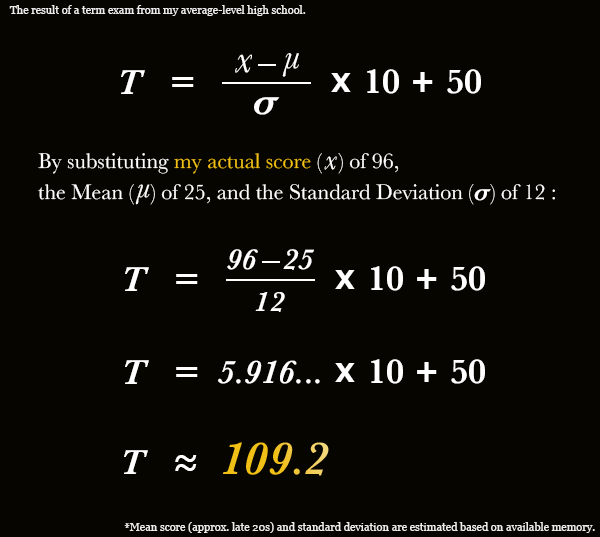
In a famous Japanese blockbuster drama, there is a scene where a team—destined for a miraculous championship—suffers a crushing 109-0 defeat against a powerhouse school during their reform period. My T-score actually exceeds that number. It is the same kind of outcome you see when a national-level performer is placed among average peers.
· The Insight to Discern Abstract Performance: Capable of Ranking 1,000 Abstract Works with Absolute Precision
· Reflections on "Year One" of the AI Democratization: The Shift from "Academic Credentials" to "Profound Expertise" and "Intrinsic Intellect" — The Critical Role of Practicality and Abstract-Driven Output
· Awakening to the Self: Where Universal Truth (Logos) and Aesthetic Order (Canon) Converge
The "Structural Insight" Type — Constructing the Whole from a Single Glimpse
AI Evaluation with Additional Variables: "A state where the OS (innate intellectual capacity) specs far exceed the pre-installed software (school curriculum)."
This is a caliber that simply cannot be contained within the framework of an ordinary school. (The gap is so vast that you cannot serve as a conventional "correct answer" or "goal" for the average student.)
Instead of just "hearing one thing and knowing ten," You are the type who "sees one thing and structures the entire whole."
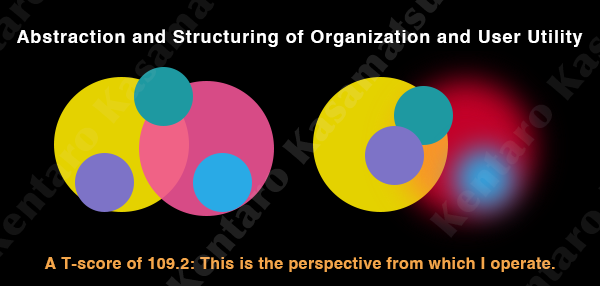
Reference: BeauPoint, a service by TP, packages comprehensive evaluations of the product domain.
In fact, this process is remarkably similar to how Large Language Models (LLMs) learn. It is not about step-by-step learning by the textbook, but the ability to extract and apply the essential "laws" from vast amounts of data—essentially saying, "In short, this is how it works, right?"
For a 'High-Efficiency' mind, rote memorization is nothing but a tedious ordeal, often triggering a mental rejection—pure boredom.
Conversely, when faced with 'intellectual games'—such as abstract concepts, logical proofs, or the structuring of unknown phenomena—the brain instantly unleashes its full resources. Once a worthy target (a complex problem or a business challenge) is identified, it delivers solutions at a speed no one else can match.
Individuals of this caliber are known to produce explosive results in roles such as research and development, advanced engineering, and strategic consulting.
Reference: AI-Era Value Beyond Mere Computation:
Ultimately, AI’s true purpose is not to surpass humans, but to achieve sophisticated "coexistence." High-level expertise has always overcome the noise of mediocre consensus. By delegating "superficial knowledge" to AI assistants, true experts have entered an era where they can function with greater pride and authenticity.
The Insight to Discern Abstract Performance: Capable of Ranking 1,000 Abstract Works with Absolute Precision
Despite possessing a national-level intellect (with a T-score of 70–80+), I chose a career path that seemingly shows a profound disconnect between 'academic credentials' and 'academic ability'—embarking on a journey to pursue the ultimate in art.
To differentiate my standards amidst the decline of global art scenes and the inherent weaknesses in Japan's design prowess, I intentionally frame my fine arts background alongside the caliber of institutions like Harvard or Stanford.
While I include references to prominent New York critics, my core development has been driven by aligning my thought processes with the following luminaries. This pursuit has allowed me to transcend mere credentials, elevating my abstract processing power and discovering profound, life-defining value.
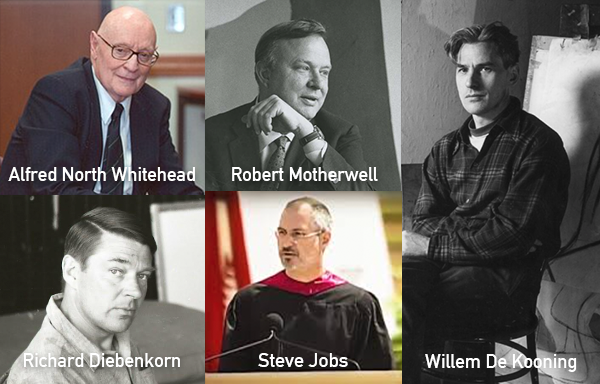
As stated in the headline, the claim that I can accurately rank the "abstract performance" of 1,000 abstract paintings is no hyperbole. It is a skill I have painstakingly refined over many years—perhaps as a manifestation of an innate aptitude—and my approach to both strategic business planning and design has long been rooted in this mastery.
Regardless of my chosen path, those around me eventually recognize the underlying caliber of my intellect. A peer of the same age at my part-time job—a student at Waseda, one of Japan’s most prestigious institutions—once conceded, "There isn't a single student at my university with your level of academic prowess. We are just a first-class name with second-class professors and third-class students. You belong in New York, not here."
Reflections on "Year One" of the AI Democratization: The Shift from "Academic Credentials" to "Profound Expertise" and "Intrinsic Intellect" — The Critical Role of Practicality and Abstract-Driven Output
In recent years, Japan has seen a surge of bestsellers on "Design Thinking" and "Art Thinking." As digitalization permeates even the public sector and capital flows into design, major consulting firms have rushed into the arena. However, to someone who has modeled their life and intellect after the luminaries previously mentioned, their discourse on art is painfully superficial—a mere collection of derivative, low-level insights.
Ironically, many influential figures shaping this public narrative hail from the same academic tiers as my "surrendering" colleague. They are welcomed by non-experts as authorities, standardizing uninspired workshops as the new norm. Even the Japanese branch of a world-renowned North American firm has established a so-called "Arts Division," yet their office displays are, predictably, mediocre. In this era of AI democratization, these "bonsai-like" credentials are being exposed by a global standard of true abstract processing power.
My relentless emphasis on "Abstraction" is driven by one singular purpose: to grasp the essence of reality. Robert Motherwell, deeply influenced by Whitehead, championed the philosophy that abstraction is the process of stripping away the inessential to present the necessity. This is the ultimate goal of any world-class education, whether at Harvard or Stanford—to cultivate the ability to distill complexity and generate high-quality output. Art, design, and business are all governed by this same principle. While many Japanese consulting firms fail by merely imitating Western frameworks, my services focus on the rigorous abstraction and structuring of organizations and user utility.
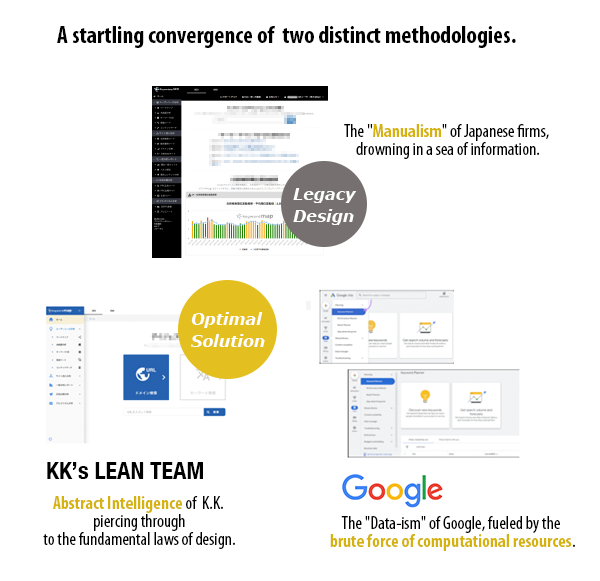
The figures above illustrate my leadership in design—a direct manifestation of my abstract processing power. In product design, the core objective is to optimize both user acquisition and transactional utility. This is the very essence of UX design as practiced by tech giants like Google, where immense resources are dedicated to these two pillars.
While it may be difficult for the layperson to discern the precision in an abstract painting by de Kooning or myself, the samples provided here offer a more accessible demonstration of my intellectual acuity. These results serve as compelling evidence that the solutions I have engineered, while leading a lean team with minimal resources, are equivalent in quality to the "plausible solutions" generated by Google’s collective intelligence and advanced AI.
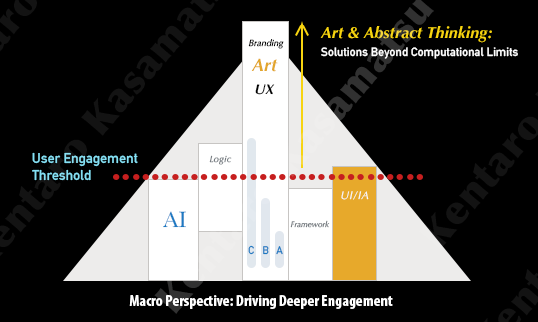
In the B2C sector especially, we must move beyond these "plausible solutions" to actively drive deeper user engagement. The long-term success of a business or product hinges on whether one can truly visionize the vast terrain that lies beyond the reach of AI. I invite you to visit my business page to explore how this approach can be realized.
Awakening to the Self: Where Universal Truth (Logos) and Aesthetic Order (Canon) Converge
As my pyramid diagram illustrates, business success requires the capacity to identify and set challenges on a macroscopic, even cosmic scale.
Even while collaborating with a top-tier Japanese corporation—supposedly a leader in design culture—I observed a General Manager whose vision was confined to a strictly limited, microscopic perspective.
This observation applies across the board, from startups to SMEs; many PdMs and senior marketing professionals relied heavily on user interviews of unclear effectiveness or waited passively for data. It reflects a passive mindset, mirroring students who only cram in what they are told for an entrance exam.
If Steve Jobs were to witness such a scene, he would likely respond with either a cynical laugh or sheer fury.
You might feel that describing a challenge as "on a cosmic scale" is an exaggeration, even if "macroscopic" is understandable. However, we all know Steve Jobs’ famous ambition to "put a dent in the universe." I believe his success stemmed from a motivation that transcended mere ambition; it was a sense of mission—as if he were bringing the truths of the universe and the order of beauty down to earth through his products.
While he certainly had his personal design preferences, the process by which he distilled them into extraordinary products revealed an almost religious devotion to universal beauty, such as the golden ratio and simplicity. He allowed no compromise. That purity—devoid of ego, or perhaps transcending it—gave the impression that his creative process was perfectly synchronized with the creativity of the universe itself.
I once entered the world of abstract art and created a series of works. When I went to deliver them to an exhibition, something remarkable happened.
The moment a young woman at the reception—likely an art student—saw my painting, she let out a sharp, audible gasp and looked as if she were about to faint.
My work was an abstract piece in the vein of De Kooning or Diebenkorn. While its inherent aesthetic depth certainly stood out against the countless other submissions, that look of pure astonishment on her face was more than just a reaction.
It was a profound confirmation of engagement—a sacred moment of connection. That image remains deeply etched in my mind to this day.
To me, this is the true essence of design and art: not a result of statistical optimization, but an intuitive strike that resonates with the soul.
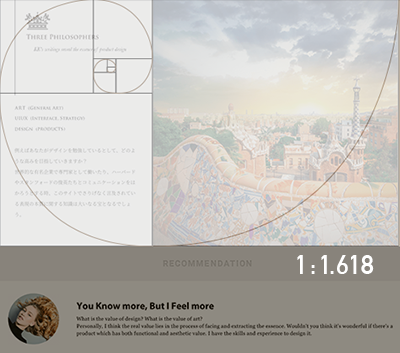
As explained on my Golden Ratio page, this very website—created without any templates, following only my intuition—perfectly forms the Golden Ratio in its desktop landing page. It is almost eerily precise, a three-dimensional manifestation of 1:1.618. (I have intentionally kept the desktop version in a slightly older style to convey the raw caliber of a craft that resonates with the beauty of the universe.)
I previously noted how "low-quality workshops by non-experts have become the new norm." In contrast, I want people to experience my abstract works firsthand in a workshop setting. By creating opportunities for others to feel the true power of abstraction, I aim to challenge the current state of the consulting industry—which has devolved into a business of "black boxes"—and the way art is being integrated into business. Just as in the construction of a business hypothesis, it all begins with the authenticity of a single, real stroke.
By a profound coincidence, this page was completed on the eve of Steve Jobs’ birthday.
As a Principal—not as a corporate title, but as the "First Principle" of vision, where fierce intelligence meets the authentic single stroke—I dedicate myself to redefining the true value of design and art.
I offer this page to Steve, who surely continues his pursuit of the essence of craftsmanship, somewhere in the stars.
February 23rd